Hydrostatic pressure equation
For a liquid of density \( \rho \) in rigid-body rotation with angular velocity \( \omega \), the hydrostatic pressure distribution is
\[ p(r,z) = \rho \frac{\omega^2 r^2}{2} - \rho g z + \text{constant}. \]The constant in this equation depends on the choice of \( z \)-origin and on the geometry and operating condition.
Recall: Free surface
See derivation (Eq. 2.32)For a liquid in a vertical cylindrical container of radius \( R \) undergoing rigid-body rotation with angular velocity \( \omega \), the free surface profile (no spilling) is
\[ z = h(r) = \frac{\omega^2 r^2}{2g} + h_0, \quad \text{where} \quad h_0 = H - \frac{\omega^2 R^2}{4g}. \]That is,
\[ z = h(r) = \frac{\omega^2 r^2}{2g} + H - \frac{\omega^2 R^2}{4g}. \]Here \( H \) is the liquid depth when the tank is at rest.
Determining the constant in the hydrostatic pressure equation
At \( r = 0 \) and \( z = h_0 \), the free surface is exposed to atmosphere, so \( p = p_{\text{atm}} = 0 \) (gauge pressure). Thus
\[ p(r,z) = \rho \frac{\omega^2 r^2}{2} - \rho g z + \text{constant} \quad\Rightarrow\quad \text{constant} = \rho g h_0 = \rho g\!\left(H - \frac{\omega^2 R^2}{4g}\right). \]Substituting back, the gauge pressure field is
\[ \begin{aligned} p(r,z) &= \rho \frac{\omega^2 r^2}{2} - \rho g z + \rho g\!\left(H - \frac{\omega^2 R^2}{4g}\right) \\ &= \rho \frac{\omega^2}{4}\bigl(2r^2 - R^2\bigr) + \rho g(H - z). \end{aligned} \]Alternative form using local liquid depth
The same expression can also be developed using \( p = \rho g\,\Delta h \), where \( \Delta h \) is the local liquid depth. For a point at \( (r,z) \),
\[ \Delta h = h - z = \frac{\omega^2 r^2}{2g} + h_0 - z. \]Therefore,
\[ \begin{aligned} p(r,z) &= \rho g\,\Delta h = \rho g(h - z) = \rho g\!\left(\frac{\omega^2 r^2}{2g} + h_0 - z\right) \\ &= \rho g\!\left(\frac{\omega^2 r^2}{2g} + H - \frac{\omega^2 R^2}{4g} - z\right) \\ &= \rho \frac{\omega^2}{4}\bigl(2r^2 - R^2\bigr) + \rho g(H - z). \end{aligned} \]Schematic
Vertical cylindrical container of radius \( R \) rotating at angular velocity \( \omega \). The bottom is at \( z = 0 \); the initial liquid depth at rest is \( H \).
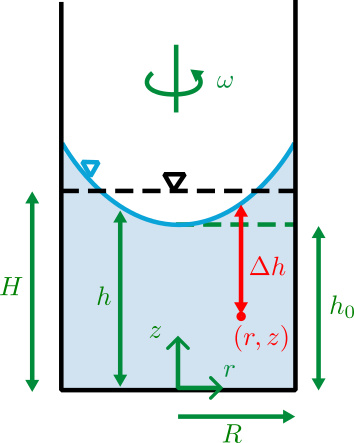
During rotation, the free surface \( z = h(r) \) becomes parabolic. The depth at the center is \( h_0 = H - \dfrac{\omega^2 R^2}{4g} \).
Inputs
Density is fixed at \( \rho = 998.2~\text{kg/m}^3 \) (water). The coordinate \( (r,z) \) defines one of the three constant-pressure lines. You can also click or drag the blue point in the first plot to adjust \( r \) and \( z \).
Outputs at \( (r,z) \)
At the blue point \( (r,z) \), the gauge pressure is \( p(r,z) \) and the local liquid depth is \( \Delta h = h(r) - z \).